
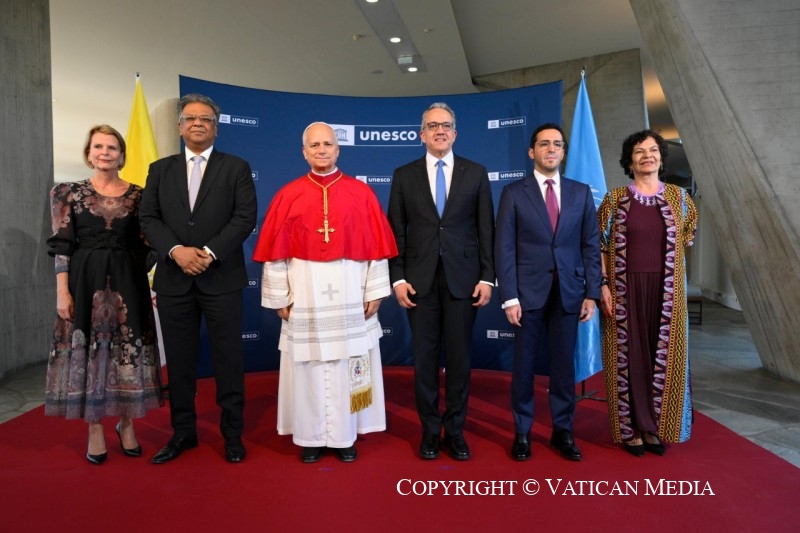

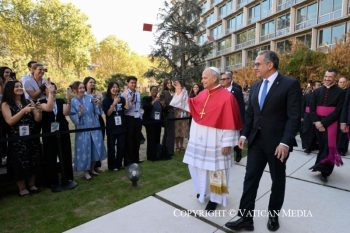
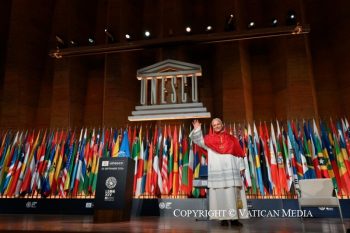
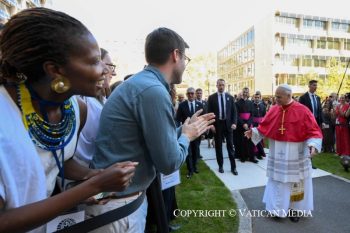
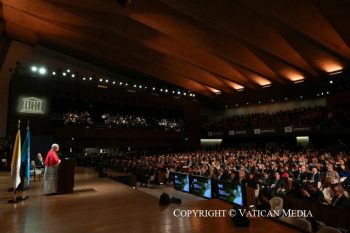
À l’UNESCO, le pape Léon XIV a appelé la communauté internationale à renouveler son engagement en faveur de la paix, en plaçant l’éducation, la science et la culture au service de la dignité humaine et du bien commun. « La paix ne peut être construite par les seuls traités », a-t-il rappelé, soulignant la nécessité d’une culture de paix et d’une volonté droite capables de reconnaître en l’autre « un frère ou une sœur ».
___________________________________
Monsieur le Directeur général,
Monsieur le Président de la Conférence Générale,
Monsieur le Président du Conseil Exécutif,
Excellences,
Mesdames et Messieurs,
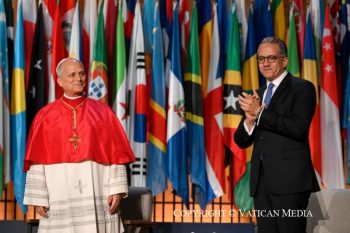
 je suis heureux de me trouver aujourd’hui au sein de cette assemblée des Nations, où les langues et les cultures se rencontrent pour coopérer à un projet qui concerne l’ensemble de la famille humaine : « Contribuer au maintien de la paix et de la sécurité en resserrant, par l’éducation, la science et la culture, la collaboration entre nations, afin d’assurer le respect universel de la justice, de la loi, des droits de l’homme et des libertés fondamentales » (Acte constitutif de l’UNESCO, art. 1, al. 1). Construire ensemble un monde juste est, en effet, le fondement même de la coopération internationale. Nos expériences, nos aptitudes et nos compétences visent à édifier un espace accueillant pour tous et fécond pour chacun, afin que tous les peuples puissent grandir dans la paix.
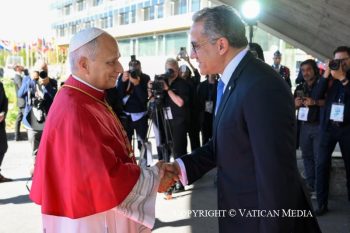
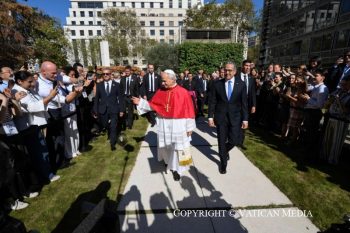
En tant que témoin de la paix, je vous adresse mes salutations cordiales, Représentants des États membres et Observateurs, des Organisations internationales, du monde universitaire et de la société civile. Je remercie Monsieur Khaled El-Enany, Directeur Général de cette Organisation, pour son invitation chaleureuse et pour les paroles qu’il nous a adressées. En ma qualité de pasteur, je vous transmets la parole de l’Église, qui se fait sans cesse “message etconversation” à l’intention de tous les peuples, femmes et hommes de bonne volonté (cf. Paul VI, Lett. enc. Ecclesiam suam, n. 67).
 Le projet de construire ensemble un monde juste coïncide avec une mission que nous avons appris à partager au fil de l’histoire. À cet égard, l’UNESCO représente à la fois un objectif et un outil pour poursuivre aujourd’hui, avec un engagement accru, cette tâche, selon nos multiples domaines d’activité. En 2027 [deux mille vingt-sept], nous célébrerons le 75e [soixante-quinzième] anniversaire de la présence du Saint-Siège à l’UNESCO : une présence qui découle de la conviction que l’avenir dépend avant tout du respect et de la promotion de la dignité inaliénable de chaque être humain créé à l’image de Dieu. C’est pourquoi nous considérons cette Organisation comme un interlocuteur privilégié au service du bien commun, qui est la “forme sociale de la dignité” que nous partageons tous de manière originelle et égale (cf. Lett. enc. Magnifica Humanitas, n. 59). Depuis 1952 [mil neuf cent cinquante-deux], la Mission permanente d’observation du Saint-Siège discerne et accompagne, dans cette perspective, les initiatives de l’UNESCO, en apportant sa contribution au dialogue entre les nations, afin de soutenir un authentique développement humain, qui n’est tel que lorsqu’il est orienté à « promouvoir tout homme et tout l’homme » (Paul VI, Lett. enc. Populorum progressio, n. 14).
 S’adressant à cette assemblée, mon vénéré prédécesseur saint Jean-Paul II rappelait que « genus humanum arte et ratione vivit ». Puisqu’en effet « l’homme vit d’une vie vraiment humaine grâce à la culture », [1] ce mot “culture” désigne la manière d’être par laquelle l’homme donne un sens à tout ce qu’il fait. Quarante-six ans plus tard, alors que je renouvelle parmi vous l’engagement de collaboration du Saint-Siège, je vous invite à considérer l’UNESCO non seulement comme une Organisation internationale illustre, mais aussi comme un lieu où l’humanité réfléchit sur elle-même, sur son histoire et sur son avenir. Promouvoir l’éducation, les sciences et la culture est en effet impossible sans promouvoir la vie de l’homme et de la femme, qui en sont les protagonistes.
Dans le domaine de l’éducation, l’Église catholique apporte une expérience très ancienne : depuis des siècles, ses communautés ouvrent des écoles et des universités, enseignent à lire et à écrire, et sont présentes même dans les endroits les plus pauvres et les plus reculés. Avec le Pacte éducatif mondial, mon prédécesseur François a souhaité inscrire cette expérience dans une alliance éducative plus large, ouverte à la contribution de tous. Mais ce que je souhaite vous transmettre, ce ne sont pas d’abord les œuvres : c’est la conviction dont elles découlent. Aucune éducation n’est complète si elle ne parle pas de la question du sens. Dans ce même discours, saint Jean-Paul II le rappelait : éduquer, c’est aider l’homme à « être » davantage et non seulement à « avoir » plus, en reconnaissant en lui aussi cette transcendance de la personne qui appartient à la plénitude de son humanité (cf. ibid., nn. 10-11).
Avant toute chose, la personne humaine est quelqu’un qui est conçu et qui naît. Ainsi, être humain, c’est d’abord être un enfant. Aucun d’entre nous n’a choisi de l’être. Aucun d’entre nous n’a décidé de qui, quand ni où naître. Cette vérité évidente met en lumière un aspect qui n’est pas seulement biologique, mais éthique : en tant qu’enfants, nous sommes tous frères et sœurs. Dès le début, notre humanité est un don et une épreuve, une promesse et une responsabilité. Pour chaque être humain, la naissance établit un lien primordial — une communion de vie qui trouve sa source, et son premier cadre éducatif, dans la famille.
 Deuxièmement, nous naissons tous nus et dans le besoin. Nous sommes pauvres dès la naissance, nous avons besoin de pain et de paroles, de soins et d’affection — c’est-à-dire de tout ce qui nourrit le corps et l’esprit. Nous le savons bien, et pourtant, en devenant adultes, nous risquons de l’oublier. Ce sont précisément ceux qui sont dans le besoin qui subissent les conséquences les plus graves de cet oubli, chaque fois que leur humanité est trahie ou mise de côté, exploitée ou trompée. Oublier les circonstances de notre naissance obscurcit l’idée même de la vie humaine, car cela détache la vie de l’histoire commune à nous tous. Ainsi, la vie n’est plus comprise comme un don, mais comme une marchandise. Elle n’est plus considérée comme un appel à la sollicitude et à la responsabilité, mais comme un produit à exploiter. En effet, cette alternative tragique nous rappelle qu’être humain, c’est être libre par nature. Puisque nous avons tous été des enfants, notre liberté commence par notre réponse à la liberté de celui qui se tourne vers nous en premier — que ce soit par des gestes d’affection ou de rejet, d’accueil aimant ou de négligence et de cruauté.
 En troisième lieu, garder vivante la mémoire de notre humanité commune, c’est reconnaître sa grandeur — c’est-à-dire son immense potentiel — même si elle est affaiblie par de nombreuses formes de mal et d’injustice. Ceux qui œuvrent dans les domaines de l’éducation, de la science et de la culture sont d’autant plus appelés à prendre soin de chaque personne, afin que la beauté de notre liberté puisse resplendir. Cette beauté a un nom : la justice. La liberté est en effet belle lorsqu’elle est orientée vers le bien et la vérité ; elle est défigurée lorsqu’elle sombre dans l’arbitraire, la violence ou la soif de pouvoir. Être humain implique donc une responsabilité devant l’histoire : l’être humain est celui qui grandit, apprend et travaille à la fois de ses mains et de son esprit. Par ce labeur, nous pouvons cultiver la terre ou la défigurer, créer des œuvres d’art ou les détruire. À ce moment précis, nous devons reconnaître que la plus terrible des « œuvres humaines » est la guerre, car alors la science elle-même est mise au service d’une volonté inhumaine de détruire et de tuer.
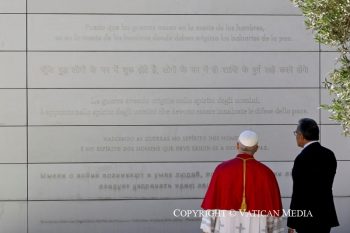
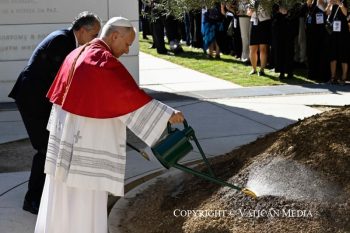
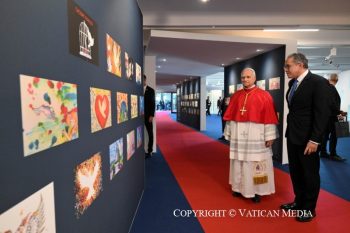
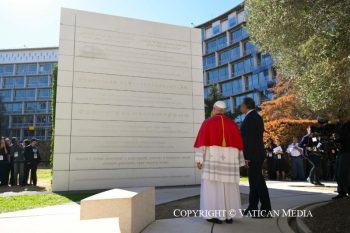 À cet égard, le préambule de la Constitution de l’UNESCO s’ouvre sur des mots qui conservent aujourd’hui une pertinence frappante – comme nous l’avons vu au « Mur de la paix » – : « Puisque les guerres prennent naissance dans l’esprit des hommes, c’est dans l’esprit des hommes que doivent être élevées les défenses de la paix » (Constitution de l’UNESCO, Préambule, 1945). Ces mots ont été écrits au lendemain de la Seconde Guerre mondiale, la tragédie la plus dévastatrice du siècle dernier. L’humanité avait pris conscience que le progrès scientifique, lorsqu’il est dissocié de la sagesse, peut se transformer en arme de destruction ; que la culture, lorsqu’elle est soumise à l’idéologie, peut dégénérer en mensonge et en propagande ; et que l’éducation, lorsqu’elle abandonne la vérité, peut devenir un instrument de manipulation des consciences. Les États fondateurs de l’UNESCO ont compris que les traités sont nécessaires, mais qu’ils ne suffisent pas à eux seuls. Ils nécessitent une culture de la paix et un engagement commun en faveur de la paix, qui les soutiennent. La paix ne peut se construire par les seuls traités, ni par des compromis entre des forces opposées. La paix est authentique lorsqu’elle jaillit de la vertu de la justice plutôt que d’un simple contrat, et d’une volonté droite plutôt que d’un équilibre instable d’intérêts. En effet, seule une volonté droite peut reconnaître dans l’autre un frère ou une sœur, une personne comme soi-même.
 Quatre-vingts ans plus tard, les paroles de votre Charte fondatrice n’ont rien perdu de leur force. Pourtant, nous constatons également à quel point ce principe commun est profondément menacé par des formes de barbarie qui alimentent la rivalité et les conflits. Parmi les défis auxquels sont confrontés aujourd’hui les mondes de la science et de l’éducation, j’attirerais particulièrement l’attention sur ceux qui découlent du vaste domaine de la technologie. Nos efforts dans ce domaine doivent garantir que les nouvelles technologies restent au service de la personne humaine, plutôt que de devenir un instrument de plus de domination et d’injustice.
Au fil des siècles, de nombreuses tâches autrefois accomplies par les êtres humains ont été confiées à des machines, dont les capacités et les applications n’ont cessé de s’étendre. Plus récemment, certains systèmes artificiels ont même reçu le nom de notre faculté humaine de pensée : l’intelligence. Dans le même temps, cependant, nos idées et nos relations risquent d’être appauvries par un processus de déshumanisation. Le paradoxe est devenu de plus en plus évident : alors que l’« intelligence » est attribuée à des systèmes informatiques, nous avons du mal à reconnaître la dignité inaliénable des personnes humaines, dont les vies sont jugées selon le critère de l’efficacité et qui, lorsqu’elles ne sont plus jugées productives, sont rejetées et mises au rebut.
 Cette douloureuse réalité nous invite à réfléchir à la fois à la fragilité de notre nature humaine et à l’immense dignité de chaque personne humaine — une dignité qui reste intacte même dans les circonstances les plus vulnérables, jusqu’à la mort elle-même. L’être humain est certes celui qui naît, mais aussi celui qui meurt. Notre dignité n’est pas détruite par la maladie ou la souffrance, et elle ne dépend pas non plus de nos capacités. Au contraire, elle appelle une attention bienveillante à chaque étape de la vie.
Pour la foi chrétienne, le mystère de la personne humaine trouve sa pleine lumière en Christ, qui, « en révélant le mystère du Père et de son amour, révèle pleinement l’humanité à elle-même et met en lumière sa très haute vocation » (CONCILE ŒCUMÉNIQUE DE VATICAN II, Constitution pastorale Gaudium et Spes, 22). À sa lumière, chaque personne nous apparaît comme une créature voulue et aimée de Dieu. Cette lumière nous aide également à saisir plus profondément le sens de notre expérience humaine commune.
Mesdames et Messieurs, en tant qu’hommes et femmes de science, vous êtes appelés à coopérer sans relâche au nom de notre histoire commune, afin que, d’une diversité de perspectives, puisse émerger une convergence de visions, et de cette convergence, une harmonie d’action. Cette harmonie s’exprime dans l’œuvre de l’UNESCO lorsqu’elle donne une voix symphonique aux plus hautes aspirations pour le bien et la protection de l’humanité. Là où règne l’harmonie, des voix différentes trouvent un accord, et les nations que vous représentez sont ainsi réunies dans la concorde.
 À cet égard, je voudrais faire appel à deux images tirées de la Bible, ce grand trésor culturel de l’humanité. Il s’agit de la tour de Babel et de la place publique de la Pentecôte. Je les propose comme moyens de représenter l’unité de la famille humaine qui, aujourd’hui encore, est sans cesse appelée à discerner la direction qui lui convient et le sens de l’histoire dans laquelle elle est plongée. Ces récits bibliques dépeignent deux formes de vie en société qui nous invitent à réfléchir sur la situation de notre temps.
La tour de Babel représente une unité imposée par la domination (cf. Gn 11, 4). En même temps, cet édifice révèle que plus le pouvoir cherche à opprimer, plus il s’affaiblit, dévoilant ainsi son visage inhumain. Nous le constatons dans les souffrances et les injustices causées par le despotisme, ainsi que dans les formes d’exploitation qui nuisent tant à la société qu’à l’environnement. Comme l’histoire nous l’enseigne, de nombreux empires se sont délectés de leur puissance avant d’être consumés par celle-ci et de s’effondrer comme une tour. Le résultat de cette fierté, d’abord exaltée puis abaissée, est la dispersion. La prétention de se faire l’égal de Dieu et de soumettre les peuples à un joug unique conduit à une confusion des langues et à une incapacité à se comprendre les uns les autres. Au lieu d’atteindre le ciel, comme elle se le permettait de le faire, la tour de Babel s’est effondrée, avec un double résultat négatif. Comme l’unité qu’elle imposait était forcée, la diversité qui a suivi son effondrement s’est transformée en source de conflit. Aujourd’hui, la tentation de Babel réapparaît dans une mondialisation poursuivie sans fraternité, dans des formes rapaces de néocolonialisme, dans les impositions idéologiques et dans tous ces « contacts sans liens » qui réduisent la vie humaine au commerce (cf. COMMISSION THÉOLOGIQUE INTERNATIONALE, Quo Vadis, Humanitas ?, 42) . La science elle-même, lorsqu’elle est réduite à une technique de pouvoir, ne sert plus à élever la personne humaine, mais risque au contraire de dégrader les fruits de l’activité humaine.
 Aujourd’hui, en particulier, nous disposons des moyens de relier instantanément les personnes et les continents ; pourtant, dans le même temps, nous assistons à de nouvelles formes d’isolement, de pauvreté matérielle et spirituelle, et d’abandon. La communication est devenue beaucoup plus rapide, mais pas nécessairement plus véridique. L’information est abondante, mais elle n’est pas synonyme de sagesse. Sans un fondement éthique commun, les nombreux canaux de communication risquent de multiplier les fausses informations et de donner du crédit à des mots vides de sens, entravant ainsi le dialogue au lieu de le favoriser.
L’intelligence artificielle amplifie ce problème. Bien que ces systèmes puissent établir des corrélations entre les données, ils ne peuvent répondre aux questions qui concernent le sens de la vie humaine, lequel est enraciné dans l’expérience vécue. Pourtant, les êtres humains ne peuvent pas vivre sans sens. Le sens est l’oxygène de l’esprit. C’est pourquoi les défis de la communication, qui sont toujours aussi des défis de l’éducation, font de la recherche de la vérité une question de justice sociale et d’équité historique. C’est pourquoi l’éducation dans ce domaine est essentielle, et je salue l’initiative de l’UNESCO à travers son programme d’éducation aux médias et à l’information (EMI), qui promeut l’utilisation responsable des médias et des outils numériques.
 En effet, sans la vérité, le langage devient soumis à la logique de la violence et à la volonté arbitraire des puissants. D’autres sont alors exclus au nom du profit, et les innocents sont tués au nom de la liberté. Au lieu de respecter la loi, ceux qui détiennent le pouvoir l’invoquent lorsqu’elle sert leurs intérêts et la bafouent lorsqu’elle les entrave, traitant même la justice elle-même comme s’il s’agissait d’une marchandise que l’on peut acheter et vendre. Si nous prenons conscience que la corruption de la loi commence par la corruption du cœur, nous pouvons reconnaître à quel point toute science risque de perdre son sens propre lorsqu’elle est pratiquée sans éthique, et cesse ainsi de servir et de refléter la dignité humaine.
À cet égard, j’encourage la communauté internationale dans son ensemble à accorder une attention particulière à la protection des enfants et des jeunes. À l’ère numérique, leur vulnérabilité ne doit jamais devenir une occasion d’exploitation. Que ces technologies favorisent leur épanouissement, leur éducation et leurs relations, en préservant leur liberté de penser et de discerner, et en restant toujours au service de la dignité de la personne humaine.
 La corruption de la culture que nous examinons trouve sa rédemption sur la place publique de la Pentecôte. Là, un message de paix est accueilli comme une bonne nouvelle par les peuples de toutes les nations. Ce message proclame la résurrection de Jésus, c’est-à-dire la victoire de la vie sur la mort et le salut qui donne de l’espoir au monde. Le jour de la Pentecôte, la place publique devient un lieu où l’on célèbre la paix qui guérit toute atteinte à la personne humaine. Chacun des présents a entendu le message « dans sa propre langue » (cf. Actes 2, 8). La communion ne supprime en rien la diversité. Au contraire, elle permet à la diversité de s’épanouir dans l’harmonie des voix et des visages. Dans la proclamation de la paix, la richesse des cultures devient porteuse d’une vérité universelle. L’enseignement biblique nous montre ainsi la voie pour parvenir à ce que nous recherchons tous : « cette unité qui n’annule pas les différences, mais valorise l’histoire personnelle de chaque personne et la culture sociale et religieuse de chaque peuple » (Homélie lors de la messe d’intronisation, 18 mai 2025). Ce n’est pas la domination de Babel, mais la paix de la Pentecôte, qui rend possible une telle communion entre tous les peuples. Chaque culture, par conséquent, réalise sa plus haute sagesse lorsqu’elle recherche la paix et le bien de tous, témoignant ainsi du sens authentique de notre humanité.
 Ceux qui œuvrent dans le domaine de l’éducation savent que seule la vérité nous rend libres. Ceux qui enseignent et ceux qui mènent des recherches savent que l’erreur nous asservit à l’ignorance et à la superstition. Chaque fois que nous rencontrons des obstacles à notre mission, rappelons-nous qu’il n’y a qu’une seule Terre pour tous et une nature humaine commune. On ne peut comprendre l’être humain en séparant ce qui ne fait qu’un : le corps et l’âme, la vie personnelle et les relations, notre rapport aux autres et à l’environnement. Tout cela fait partie de l’unité de notre existence. C’est pourquoi cultiver la terre, c’est aussi cultiver l’humanité qui l’habite. L’éducation et la science sont appelées à cette tâche. En effet, ce n’est pas un hasard si toute culture, selon l’étymologie même du mot, est un acte de culture. Je renouvelle donc l’appel de mes prédécesseurs à prendre soin ensemble de la personne humaine et de la création : le pape Benoît XVI a évoqué la nécessité d’une écologie de la personne humaine, tandis que le pape François a développé la perspective d’une écologie intégrale (cf. Benoît XVI, Discours au Bundestag, 22 septembre 2011 ; François, Lettre encyclique Laudato Si’, 137–162).
 La pierre de touche qui nous permet d’évaluer notre engagement est l’attention que nous portons aux plus petits et aux pauvres : les enfants dans le sein de leur mère et sur les différents théâtres de guerre, les personnes souffrant d’un handicap physique ou intellectuel, les personnes âgées, les migrants, les réfugiés et tous ceux qui sont arrogamment exclus sous prétexte qu’ils ne sont pas productifs. Ils constituent le véritable test de nos prétentions au respect de la dignité humaine, et leur protection et leur promotion s’étendent également à la création. À cela s’oppose une volonté d’exploiter et de piller, en tirant le maximum de chaque être vivant, en consommant sans préserver, en détruisant sans cultiver. Ainsi, la crise écologique actuelle est une crise anthropologique ; de plus, l’Église est convaincue que chaque culture porte en elle une sagesse qui mûrit au sein d’un écosystème de peuples. L’habitat de la personne humaine, c’est la société — non pas un environnement purement physique, comme le désert ou l’océan pour les animaux, mais un environnement moral et relationnel. Là où règne la paix sociale, les peuples s’épanouissent dans la justice.
 C’est donc là que l’UNESCO trouve la synthèse de ses hautes missions éducatives et scientifiques : dans le travail patient de construction de la paix. Face aux nombreuses et complexes urgences de notre époque, le monde considère les institutions internationales avec des sentiments contrastés. D’une part, celles-ci sont appelées à relever des défis qu’aucun État ne peut affronter seul. D’autre part, ces mêmes institutions traversent une crise d’efficacité, surtout lorsque le dialogue est considéré comme un frein à l’action au lieu d’une ressource pour la paix ; comme une forme d’hypocrisie plutôt que comme une occasion de rechercher ensemble le bien. Face à ces dérives, il faut promouvoir une vertu, aussi rare que désirée : la confiance ; confiance que les différences ne constituent pas nécessairement une menace ; confiance que le dialogue sincère peut engendrer un bien plus grand que celui que chacun pourrait obtenir seul. Le Saint-Siège souhaite insuffler cette confiance à l’UNESCO, comme aux autres organisations internationales, conscient que chaque peuple possède une richesse à partager dans la recherche de ce progrès authentique que seule la paix peut garantir. Il ne s’agit pas de prôner un optimisme naïf, qui ignore les difficultés, mais de persévérer dans l’espoir que le bien est toujours possible. Chaque enfant qui naît apporte de l’espérance. Chaque homme et chaque femme qui consacre sa vie à la recherche de la vérité accomplit un acte d’espérance. Que l’UNESCO témoigne donc de cet espoir en favorisant l’entente entre les nations, par le dialogue entre leurs cultures respectives. Nous croyons, en effet, que l’éducation est l’instrument qui permet de surmonter les peurs réciproques et que la science peut être au service de la vie de chaque être humain, en semant aujourd’hui les graines d’une bonne récolte pour l’avenir. Cette confiance nourrit notre espérance dans la charité, c’est-à-dire dans le service pour le bien du prochain : en nous consacrant tous, avec cohérence, à notre magnifique humanité, la paix pourra enfin s’épanouir.
 Alors que nous coopérons à cette œuvre, les traditions religieuses jouent un rôle culturellement nécessaire et irremplaçable, et les religions expriment nos interrogations face à l’origine de la vie et à sa fin, en élaborant le sens premier et ultime de l’existence, qui se reflète dans les choix quotidiens. En effet, lorsque les hommes et les femmes de bonne volonté orientent leurs actions vers Dieu, le pluralisme des cultures ne se disperse pas dans le désordre de Babel. L’humanité se retrouve au contraire dans une recherche commune de sens, et vers une destinée qui n’est pas la mort. Nous ne sommes pas en chemin vers le néant. C’est pourquoi l’âme humaine, dans sa relation avec Dieu, ressent encore mieux l’appel à cultiver la paix au moyen d’une alliance entre des peuples qui se reconnaissent comme enfants du même Père et comme frères et sœurs.
Je souhaite donc que notre rencontre renforce l’engagement de chacun à œuvrer sans relâche pour que la conscience d’appartenir à une seule famille humaine devienne plus vivante, plus active et plus juste. À cet égard, je tiens à exprimer mes sincères remerciements à l’ensemble du personnel de l’UNESCO, qui accomplit avec compétence et dévouement cette mission si noble : édifier la paix en cultivant toutes les sciences et tous les arts de l’homme.
Je vous adresse ces paroles à vous tous, aux peuples que vous représentez, et tout particulièrement aux jeunes. Ce sont en effet les nouvelles générations qui observent avec le plus d’attention notre action. Tout en soutenant leurs aspirations à la justice, c’est avec gratitude et estime que j’invoque sur vous tous et sur vos nations l’abondance des bénédictions de Dieu, Créateur tout-puissant et miséricordieux. Merci.
[1] Discours à l’UNESCO, 2 juin 1980. Cf. Thomas d’Aquin, In Aristotelis Posteriora Analytica, 1.
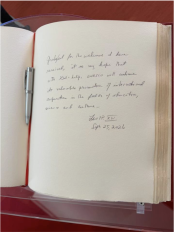
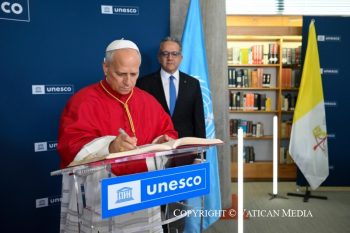
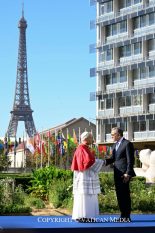
Lors de sa visite à l’UNESCO ce 25 septembre, le pape Léon XIV a signé le Livre d’Or. Il y a laissé un message d’espérance pour la poursuite de la coopération internationale dans les domaines de l’éducation, de la science et de la culture.
“Grateful for the welcome I have received, it is my hope that, with God’s help, UNESCO will continue its valuable promotion of international cooperation in the fields of education, science and culture.”
« Reconnaissant pour l’accueil qui m’a été réservé, j’espère qu’avec l’aide de Dieu, l’UNESCO continuera à promouvoir de manière précieuse la coopération internationale dans les domaines de l’éducation, de la science et de la culture. »